
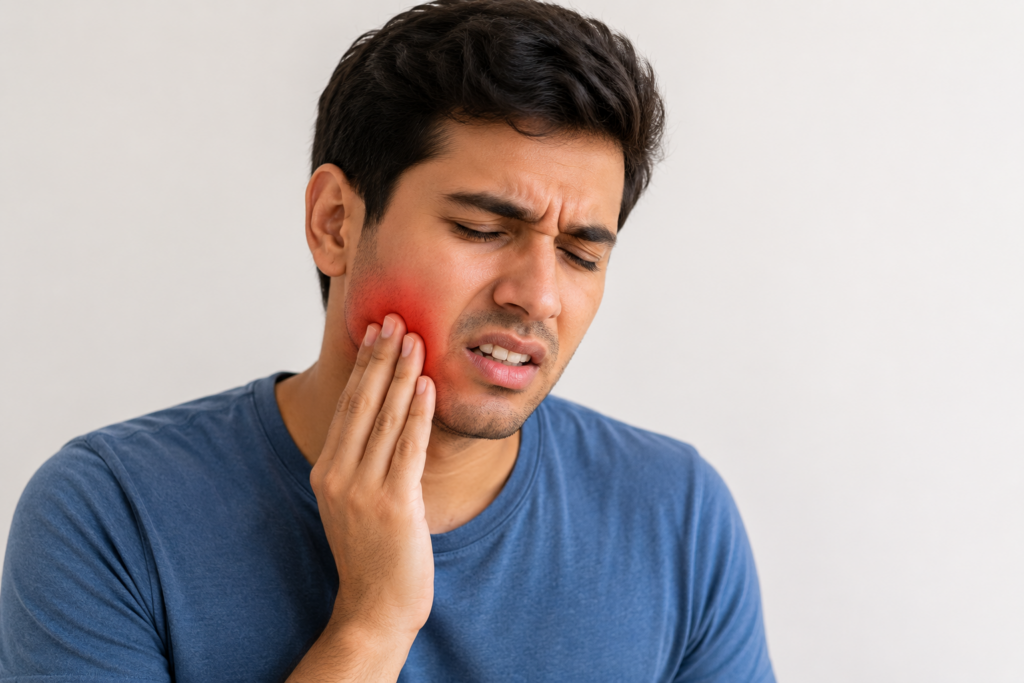
Have you noticed pain in your jaw when chewing, talking, yawning, or opening your mouth?
Maybe you feel a dull ache near your ear. Perhaps your jaw clicks when you open your mouth, or you wake up with a tight or tired jaw.
Jaw pain can have several causes.
Sometimes it is related to the jaw joint or muscles. In other cases, a dental problem such as an infection, wisdom tooth problem, or bite issue may be responsible.
The important thing is to understand why your jaw hurts rather than simply ignoring the discomfort.
Where Is Jaw Pain Usually Felt?
Jaw pain can occur in different areas, including:
- In front of the ear
- Along the lower jaw
- Near the cheek
- Around the jaw joint
- Near the teeth
- Along the jaw muscles
- On one or both sides of the face
The location of the pain can provide useful clues, but it does not always identify the exact cause.
A dental examination may be needed to determine whether the problem is coming from a tooth, jaw joint, muscles, gums, or another structure.
1. Temporomandibular Joint (TMJ) Problems
The temporomandibular joints connect your lower jaw to your skull.
These joints help you perform everyday movements such as:
- Chewing
- Talking
- Yawning
- Opening and closing your mouth
Problems involving the jaw joint and surrounding muscles are commonly referred to as temporomandibular disorders (TMD).
Symptoms may include:
- Jaw pain
- Clicking or popping
- Difficulty opening the mouth
- Pain while chewing
- Facial discomfort
- Ear-area pain
- Headaches
- Jaw stiffness
AK Dental already has a detailed article explaining TMJ disorder, so this article focuses specifically on helping patients understand when jaw pain may be a sign that they should seek an evaluation.
2. Teeth Grinding and Jaw Clenching
Do you wake up with a sore jaw?
Do you notice that you clench your teeth when you’re concentrating or stressed?
Teeth grinding and jaw clenching can place excessive pressure on the teeth and jaw muscles.
Over time, this may contribute to:
- Jaw pain
- Muscle tenderness
- Headaches
- Tooth sensitivity
- Worn teeth
- Cracked or damaged teeth
- Increased pressure around the jaw joint
Some people grind their teeth primarily while sleeping and may not realize they are doing it.
If your jaw feels tired or painful when you wake up, mention this to your dentist.
3. Wisdom Teeth Problems
Wisdom teeth are the last molars to develop and may not always have enough room to erupt properly.
A partially erupted or impacted wisdom tooth can sometimes cause:
- Pain at the back of the jaw
- Swelling
- Gum tenderness
- Difficulty opening the mouth
- Pain while chewing
- Bad taste or bad breath
- Repeated gum infections
If your jaw pain is located toward the back of your mouth, particularly near a wisdom tooth, your dentist may need to examine the area and take dental X-rays.
AK Dental already has an educational article covering wisdom teeth, including their symptoms and treatment options.
4. Dental Infection or Tooth Abscess
Sometimes what feels like jaw pain is actually coming from an infected tooth.
A dental infection can cause pain that spreads into the surrounding jaw, face, or ear area.
Other warning signs may include:
- Severe toothache
- Pain while chewing
- Sensitivity to hot or cold
- Swollen gums
- Facial swelling
- Pus around the tooth
- Bad taste
- Fever
An infected tooth should not be ignored.
If the tooth can be saved, root canal treatment may be recommended to remove the infected tissue and preserve the natural tooth. AK Dental’s root canal service specifically lists severe pain while chewing or biting, swelling, lingering hot/cold sensitivity, and signs of infection among symptoms requiring evaluation.
5. Bite or Teeth Alignment Problems
The way your upper and lower teeth come together can affect how pressure is distributed throughout your mouth.
If your bite is uneven or your teeth are significantly misaligned, certain teeth or jaw muscles may experience additional stress.
You may notice:
- Jaw discomfort
- Difficulty chewing
- Teeth touching unevenly
- Jaw fatigue
- Tooth wear
- Difficulty biting comfortably
Orthodontic treatment may be considered when tooth alignment or bite problems are contributing to the issue.
AK Dental provides metal braces, ceramic braces, and clear aligners for various alignment and bite concerns.
6. Jaw Muscle Strain
Your jaw muscles work throughout the day whenever you chew, speak, swallow, or move your mouth.
Excessive chewing, prolonged clenching, or repeatedly eating very hard or chewy foods can sometimes make these muscles sore.
You may notice that the pain becomes worse after:
- Chewing gum for long periods
- Eating very hard foods
- Long meals
- Clenching your teeth
- Yawning widely
If the discomfort is related to muscle strain, your dentist can help determine whether the jaw muscles or joint are involved.
7. Dental Treatment or Jaw Injury
Jaw discomfort can sometimes occur after dental treatment or an injury.
For example, keeping your mouth open for an extended period during a dental procedure may temporarily make the jaw muscles feel tired or sore.
Similarly, an injury to the face or jaw can cause pain and swelling.
If jaw pain follows an accident or significant impact, it should be professionally assessed.
Why Does My Jaw Hurt When I Chew?
Pain while chewing can have several possible causes.
The problem may be related to:
- TMJ problems
- Teeth grinding
- An infected tooth
- Wisdom teeth
- A cracked tooth
- Gum problems
- Bite issues
- Jaw muscle strain
If chewing consistently causes pain, don’t simply switch sides and continue eating.
A dental examination can help determine what is causing the discomfort.
Why Does My Jaw Hurt Near My Ear?
The jaw joint is located just in front of the ear.
Because of this, problems involving the TMJ can sometimes feel like ear pain or discomfort around the ear.
However, not every type of pain near the ear is caused by the jaw.
Dental problems, muscle tension, and other conditions can produce pain in a similar area.
If you have persistent pain near your ear and jaw, a professional evaluation can help determine the cause.
Why Does My Jaw Click When I Open My Mouth?
Some people notice clicking or popping sounds when opening or closing their mouth.
A clicking sound does not necessarily mean that you have a serious problem.
However, if clicking is accompanied by:
- Pain
- Jaw locking
- Difficulty opening your mouth
- Difficulty chewing
- Increasing discomfort
you should have the jaw evaluated.
Can Teeth Grinding Cause Jaw Pain?
Yes.
Repeated clenching and grinding can place significant pressure on the muscles and joints responsible for jaw movement.
You may experience:
- Morning jaw pain
- Facial muscle tenderness
- Headaches
- Tooth sensitivity
- Worn-down teeth
- Cracked teeth
If you suspect that you grind your teeth at night, talk to your dentist.
Your dentist can examine your teeth and jaw for signs of excessive bite forces.
Is Jaw Pain a Sign of a Dental Infection?
It can be.
An infected tooth may cause pain that spreads into the surrounding jaw.
This is more likely if jaw pain occurs together with:
- Toothache
- Swelling
- Pain when biting
- Sensitivity
- Pus
- Fever
- Bad taste
A dental infection should be evaluated promptly.
If you have facial swelling, difficulty swallowing, or difficulty breathing, seek urgent medical attention.
When Is Jaw Pain an Emergency?
Not all jaw pain is an emergency.
However, seek urgent medical or dental care if jaw pain is accompanied by:
- Significant facial swelling
- Rapidly increasing swelling
- Difficulty breathing
- Difficulty swallowing
- High fever
- Severe dental infection symptoms
- Significant trauma to the face or jaw
- Inability to open or close the mouth normally
Jaw pain accompanied by chest pain, shortness of breath, sweating, nausea, or pain spreading to the arm or shoulder can be a medical emergency and should not simply be assumed to be a dental problem.
How Is Jaw Pain Diagnosed?
The first step is finding the cause.
Your dentist may examine:
- Your teeth
- Gums
- Bite
- Jaw movement
- Jaw muscles
- TMJ area
- Wisdom teeth
- Existing dental restorations
Depending on your symptoms, dental X-rays or other imaging may be recommended.
The examination helps determine whether the pain is primarily dental, muscular, joint-related, or associated with another oral problem.
How Is Jaw Pain Treated?
Treatment depends on the cause.
For example:
TMJ-related problems:
Your dentist may recommend conservative measures, bite assessment, or other appropriate TMJ management.
Teeth grinding:
Your bite and signs of tooth wear may be evaluated, and protective measures may be discussed.
Wisdom tooth problems:
The tooth may need monitoring, treatment, or removal depending on its position and condition.
Dental infection:
Root canal treatment or another appropriate dental procedure may be required.
Bite or alignment problems:
Braces or clear aligners may be considered when orthodontic treatment is appropriate.
Tooth damage:
A filling, crown, or other restoration may be recommended depending on the condition of the tooth.
The most effective treatment is the one that addresses the underlying cause of the jaw pain.
Can Jaw Pain Go Away on Its Own?
Sometimes temporary jaw discomfort may improve, particularly when it is caused by short-term muscle strain.
However, recurring or persistent jaw pain shouldn’t simply be ignored.
If the pain keeps returning, becomes worse, or interferes with eating or opening your mouth, schedule a dental evaluation.
Treating the underlying problem early may help prevent it from becoming more complicated.
What Can You Do at Home for Mild Jaw Discomfort?
While you should seek professional advice for persistent symptoms, some simple measures may help with mild temporary discomfort:
- Choose softer foods for a short period.
- Avoid chewing gum.
- Avoid very hard or chewy foods.
- Try not to clench your teeth.
- Avoid opening your mouth extremely wide.
- Follow your dentist’s advice if you already have a diagnosed jaw condition.
Don’t repeatedly press or move the jaw to test whether it still hurts.
If symptoms continue, arrange an examination.
How Can You Prevent Jaw Pain?
Some habits may help reduce unnecessary stress on your jaw.
Avoid excessive chewing
Long periods of chewing gum or very chewy foods can place additional stress on the jaw muscles.
Be aware of clenching
Try to notice whether you hold your teeth tightly together during the day.
Protect your teeth
If you grind your teeth, discuss the problem with your dentist.
Maintain good oral hygiene
Dental infections and tooth problems can contribute to pain that spreads toward the jaw.
Treat dental problems early
Cavities, cracked teeth, gum disease, and wisdom tooth problems are easier to manage when identified early.
Attend regular dental check-ups
Routine dental examinations can help identify problems before they develop into more serious symptoms.
Jaw Pain Evaluation at AK Dental Clinic
At AK Dental Clinic in Manikonda, Hyderabad, our dental team can evaluate jaw pain by examining the teeth, gums, bite, jaw movement, and surrounding structures.
Depending on the cause, treatment may involve general dental care, root canal treatment, wisdom tooth management, bite evaluation, or orthodontic treatment.
AK Dental provides comprehensive general dentistry services including dental examinations, fillings, gum care, and preventive dental care.
For patients with alignment or bite concerns, AK Dental provides braces and clear aligners with personalized orthodontic treatment planning.
For dental infections affecting the tooth and surrounding area, root canal treatment may be recommended when the natural tooth can be preserved.
AK Dental Clinic is located in Manikonda, Hyderabad, and is led by Dr. Anirudh Kadiyal (MDS), with 16+ years of clinical experience.
Patients from Manikonda, Narsingi, Gachibowli, Puppalaguda, Kokapet, Financial District and nearby areas can visit the clinic for a dental evaluation.
Frequently Asked Questions
Why does my jaw hurt when I chew?
Jaw pain while chewing can be caused by TMJ problems, teeth grinding, an infected tooth, wisdom teeth, bite problems, a cracked tooth, or jaw muscle strain. A dental examination can help identify the cause.
Why does my jaw hurt near my ear?
The jaw joint is located close to the ear, so TMJ problems can cause discomfort in this area. However, dental and other conditions can also cause pain near the ear.
Why does my jaw click when I open my mouth?
Jaw clicking can occur for several reasons and isn’t always a sign of a serious problem. If clicking occurs with pain, locking, or difficulty opening your mouth, see a dentist.
Can teeth grinding cause jaw pain?
Yes. Grinding and clenching can place excessive pressure on the jaw muscles and joints and may cause jaw pain, headaches, tooth sensitivity, and tooth wear.
Can a tooth infection cause jaw pain?
Yes. An infected tooth can cause pain that spreads into the surrounding jaw. Swelling, fever, pus, severe toothache, or pain while biting can be warning signs.
When should I see a dentist for jaw pain?
See a dentist if your jaw pain is persistent, recurring, getting worse, interfering with chewing, or accompanied by swelling, tooth pain, clicking with pain, or difficulty opening your mouth.
Can jaw pain go away without treatment?
Temporary muscle discomfort may improve on its own, but persistent or recurring jaw pain should be evaluated to determine the underlying cause.
Can braces or aligners help jaw pain?
Braces and aligners can correct certain tooth alignment and bite problems. Whether orthodontic treatment can help your jaw symptoms depends on the underlying cause.
Is jaw pain always caused by TMJ problems?
No. TMJ problems are one possible cause, but dental infections, wisdom teeth, tooth grinding, bite issues, muscle strain, and injuries can also cause jaw pain.
Don’t Ignore Persistent Jaw Pain
Jaw pain can be caused by something as simple as temporary muscle strain, but it can also be a sign of a dental infection, wisdom tooth problem, excessive grinding, bite issue, or TMJ disorder.
You don’t have to guess what is causing it.
If you’re experiencing persistent jaw pain, pain while chewing, clicking with discomfort, or difficulty opening your mouth, book a dental evaluation at AK Dental Clinic in Manikonda, Hyderabad.
Our dental team can assess the possible cause and recommend the appropriate treatment for your condition.