
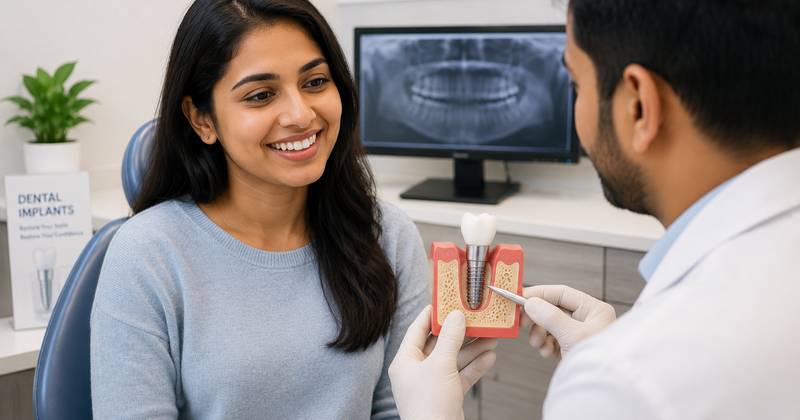
Have you lost one or more teeth and are considering dental implants?
Dental implants can provide a stable, natural-looking way to replace missing teeth. But not everyone is automatically a candidate for implant treatment.
Your dentist needs to consider several factors, including your gums, jawbone, remaining teeth, bite, general health and ability to maintain good oral hygiene.
The good news is that even if you are not immediately ready for an implant, there may be treatment options that can improve your oral condition and make implant treatment possible.
In this guide, we’ll explain who may be a good candidate for dental implants and what your dentist will evaluate before recommending treatment.
What Is a Dental Implant?
A dental implant is an artificial tooth root placed into the jawbone to support a replacement tooth.
A typical implant restoration includes:
- Implant fixture
- Abutment
- Dental crown
The implant provides a stable foundation for replacing a missing tooth while helping restore chewing function and appearance.
Who May Be a Good Candidate for Dental Implants?
In general, you may be a candidate for dental implants if you:
- Have one or more missing teeth
- Have healthy or treatable gums
- Have adequate jawbone or can undergo appropriate bone-related treatment if required
- Have good oral hygiene
- Are able to maintain regular dental care
- Have realistic expectations about treatment
- Are medically suitable for the procedure
However, only a dental examination can determine whether implants are appropriate for you.
1. You Have One or More Missing Teeth
Dental implants can be used in several situations.
They may be considered for:
A single missing tooth
A single implant can support an individual crown and replace one missing tooth without relying on neighboring teeth for support.
Multiple missing teeth
Several implants can sometimes support an implant-supported bridge or other restoration.
Multiple or complete tooth loss
Depending on the patient’s needs, implant-supported solutions may also be considered for people who have lost many or all of their teeth.
The appropriate treatment depends on the number and position of missing teeth and your overall oral condition.
2. You Have Healthy or Treatable Gums
Healthy gums are important for successful implant treatment.
Active gum disease can affect the tissues supporting teeth and implants.
If you have bleeding gums, gum swelling, loose teeth or other signs of periodontal disease, your dentist may recommend treating the gum condition before proceeding with implant placement.
This is one reason an implant consultation involves more than simply looking at the missing tooth.
3. You Have Enough Jawbone
Dental implants need adequate bone support.
When a natural tooth is lost, the bone surrounding the previous tooth root can gradually change.
Some patients have sufficient bone for implant placement, while others may have reduced bone volume.
If there isn’t enough bone, your dentist may discuss additional procedures that could improve the implant site.
Whether these procedures are necessary depends on your individual anatomy and treatment plan.
4. You Maintain Good Oral Hygiene
Dental implants are not maintenance-free.
You still need to:
- Brush regularly
- Clean between your teeth
- Keep the implant area clean
- Attend dental check-ups
- Follow your dentist’s maintenance recommendations
Good oral hygiene helps protect the gums and tissues around the implant.
5. You Are Prepared for the Treatment Process
Dental implant treatment generally takes longer than a conventional dental filling or bridge.
Depending on the case, treatment may involve:
- Examination and diagnosis
- Dental imaging
- Treatment planning
- Implant placement
- Healing and bone integration
- Placement of the final restoration
The exact sequence and duration vary from patient to patient.
Understanding the treatment process before starting can help you have realistic expectations.
6. Your Overall Health Is Suitable
Your dentist will consider your general health before recommending implant treatment.
Certain medical conditions, medications, or healing issues may affect treatment planning.
This does not automatically mean you cannot have dental implants.
Instead, your dentist may need additional information or may recommend addressing certain factors before treatment.
Always tell your dentist about relevant medical conditions and medications so that treatment can be planned safely.
7. You Don’t Smoke or Are Willing to Address Tobacco Use
Smoking and tobacco use can affect oral health and healing.
If you smoke, discuss this with your dentist before implant treatment.
Your dentist can explain how tobacco use may affect healing and the long-term health of the tissues around an implant.
8. You Have Realistic Expectations
Dental implants can restore chewing function and provide a natural-looking replacement for missing teeth.
However, an implant is not exactly the same as a natural tooth.
The final result depends on factors such as:
- Bone and gum condition
- Implant position
- Quality of the restoration
- Oral hygiene
- Bite
- Individual healing
A good implant consultation should include a discussion of what can realistically be achieved.
Can Older Adults Get Dental Implants?
Age alone does not automatically prevent someone from receiving dental implants.
The more important considerations are generally oral health, bone condition, general health, healing ability and whether the patient can maintain appropriate dental care.
Older adults should have a comprehensive assessment rather than assuming they are too old for implants.
Can You Get an Implant If You Have Bone Loss?
Possibly.
Some patients with reduced bone volume may still be candidates for implant treatment after appropriate evaluation.
Depending on the location and amount of bone available, your dentist may discuss additional procedures to improve the implant site.
A dental scan or other imaging may be recommended to evaluate the bone and surrounding structures.
Can You Get Implants If You Have Gum Disease?
Active gum disease should generally be addressed before implant placement.
Your dentist may first recommend periodontal treatment and improved oral hygiene.
Once the gums and supporting tissues are healthier, your suitability for implant treatment can be reassessed.
What If You Have Diabetes?
Having diabetes does not automatically mean you cannot receive dental implants.
However, your dentist will consider your overall health and how well the condition is controlled.
Good communication between you and your healthcare providers may be important when planning treatment.
Your dentist can explain what information is needed before proceeding.
What Happens During an Implant Consultation?
At AK Dental Clinic, an implant consultation begins with an evaluation of your individual dental condition.
Your dentist may assess:
- Missing teeth
- Remaining teeth
- Gum health
- Jawbone
- Bite
- Oral hygiene
- Previous dental treatment
- Overall health
- Your expectations
Dental X-rays or other imaging may be recommended when necessary.
The purpose is not simply to determine whether you can have an implant. It is to determine which treatment approach is most appropriate for your situation.
What If I’m Not Ready for an Implant Yet?
Don’t assume that being unsuitable for an implant today means you can never have one.
Your dentist may recommend treatment such as:
- Gum disease treatment
- Tooth extraction when necessary
- Bone-related procedures
- Improvement of oral hygiene
- Treatment of active dental infections
- Restoration of other teeth
After these issues are addressed, your suitability for implant treatment can be reassessed.
Dental Implant vs Other Tooth Replacement Options
Dental implants aren’t the only way to replace missing teeth.
Depending on your situation, your dentist may discuss:
Dental Implant
A replacement tooth supported by an implant placed in the jawbone.
Dental Bridge
A fixed replacement tooth supported by adjacent teeth or implants.
Denture
A removable appliance that replaces one or multiple missing teeth.
Each option has advantages and limitations.
The best choice depends on your oral health, number of missing teeth, bone condition, preferences and treatment goals.
Why Choose AK Dental Clinic for Dental Implants?
At AK Dental Clinic in Manikonda, Hyderabad, we provide customized dental implant treatment based on each patient’s individual needs.
Our dental implant approach includes:
- Detailed oral examination
- Digital imaging when required
- Customized treatment planning
- Implant placement
- Healing and integration
- Placement of a suitable crown or prosthesis
The clinic provides dental implants along with root canal treatment, crowns, bridges, braces, aligners, cosmetic dentistry and general dental care.
Patients from Manikonda, Narsingi, Gachibowli, Puppalaguda, Kokapet, Financial District and surrounding areas can visit the clinic for an implant consultation.
Frequently Asked Questions
Am I too old for dental implants?
There is no simple age cutoff for dental implants. Your dentist will consider your oral health, bone, general health and ability to maintain the implant.
Do I need enough bone for a dental implant?
Adequate bone support is important. If bone volume is insufficient, additional treatment may sometimes be considered.
Can smokers get dental implants?
Smoking can affect healing and the tissues around implants. Discuss your smoking habits with your dentist before treatment.
Can I get an implant if I have gum disease?
Active gum disease should generally be treated before implant placement. Your dentist can evaluate your gums and create a treatment plan.
How long does dental implant treatment take?
The timeline varies depending on the patient’s bone condition, need for additional procedures, healing and the type of restoration required.
Are dental implants suitable for everyone?
No. Suitability depends on individual oral and general health factors. A dental examination is necessary before making a recommendation.
Find Out If Dental Implants Are Right for You
If you’re living with a missing tooth, you don’t have to guess whether dental implants are suitable for you.
A proper examination can help determine the condition of your gums, jawbone, surrounding teeth and bite and identify the most appropriate tooth-replacement options.
Book a dental implant consultation at AK Dental Clinic, Manikonda, Hyderabad, to discuss your options and create a treatment plan based on your individual needs.