
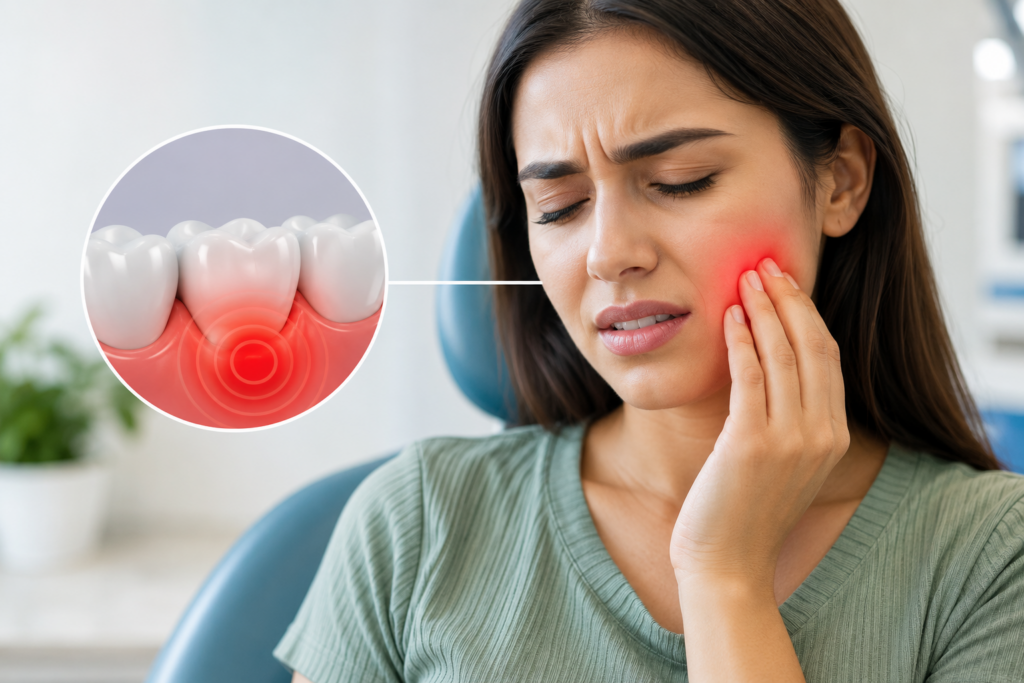
Have you noticed that one particular tooth hurts when you bite down, chew food, or put pressure on it?
You may not have pain all the time. Sometimes the tooth feels completely normal until you bite into something hard or chew on that side.
This type of tooth pain can have several possible causes.
A tooth that hurts when biting doesn’t necessarily mean you need a root canal. The cause could be anything from tooth decay or a cracked tooth to a problem with an existing filling, crown, your bite, or the tissues around the tooth.
The important thing is not to ignore persistent pain when chewing.
Let’s look at some of the most common reasons a tooth may hurt when you bite down.
1. Tooth Decay
One of the common causes of tooth pain is dental decay.
As a cavity becomes deeper, it can eventually affect the inner structures of the tooth.
You may notice:
- Pain when chewing
- Sensitivity to hot or cold
- Food getting stuck around the tooth
- Occasional toothache
- Increased sensitivity to sweets
A small cavity may sometimes be treated with a dental filling. AK Dental Clinic provides dental fillings to restore teeth affected by cavities, decay, and minor damage.
However, if decay has progressed deep into the tooth, a filling may no longer be sufficient.
2. A Cracked or Fractured Tooth
A cracked tooth can cause a very specific type of pain.
You may feel a sharp pain when biting down, particularly when chewing certain foods.
Sometimes the pain is more noticeable when you release your bite rather than when you first bite down.
Cracks can be difficult to see because they may be very small.
You may not notice anything unusual when looking at the tooth yourself.
If a tooth has been damaged or weakened, your dentist may need to examine it carefully to determine whether a crack is present and how extensive it is.
Depending on the situation, treatment may involve restoring and protecting the tooth with a crown or, if the crack has severely damaged the tooth, considering other treatment options.
3. Infection Inside the Tooth
If bacteria reach the inner pulp of a tooth, the tissue inside the tooth can become inflamed or infected.
Pain when chewing or biting can be one of the symptoms.
Other signs may include:
- Severe or persistent tooth pain
- Sensitivity to hot or cold that lingers
- Swelling around the tooth
- Tender gums
- Darkening of the tooth
- Pus or an unpleasant taste
A tooth infection should not be ignored.
Root canal treatment may be recommended when the pulp inside the tooth is infected or significantly damaged. The purpose of root canal treatment is to remove the infected tissue, clean the canals, seal the tooth, and preserve the natural tooth where possible.
4. A Problem With an Existing Filling or Crown
If you’ve recently had a filling or crown placed and the tooth hurts when you bite, your bite may need to be checked.
Sometimes a restoration can feel slightly high, meaning that particular tooth receives more pressure when you close your mouth.
You may notice:
- Pain when biting
- The feeling that one tooth touches first
- Discomfort when chewing
- Jaw or tooth pressure
An existing filling or crown can also become damaged or loose over time.
Your dentist can examine the restoration and your bite to determine what is causing the discomfort.
If a tooth has significant damage or weakness, a dental crown may be recommended to restore its strength and protect it. AK Dental Clinic provides ceramic, porcelain-fused-to-metal, and zirconia crown options depending on the patient’s needs.
5. Gum or Supporting Tissue Problems
Tooth pain isn’t always caused by the tooth itself.
The gums and tissues supporting the tooth can also become inflamed.
Gum problems may cause:
- Tenderness around a tooth
- Bleeding while brushing
- Swollen gums
- Bad breath
- Pain when chewing
- A feeling that the tooth is uncomfortable or sensitive
If the area around a tooth is inflamed, chewing pressure can make the discomfort more noticeable.
Your dentist can examine both the tooth and surrounding gum tissue to identify the source.
6. Teeth Grinding or Excessive Bite Pressure
Do you grind or clench your teeth?
You may be putting much more pressure on your teeth than you realize.
Teeth grinding and clenching can contribute to:
- Tooth sensitivity
- Cracks or tooth wear
- Jaw discomfort
- Headaches
- Pain while chewing
- Increased pressure on dental restorations
Some people grind their teeth mainly while sleeping and may not realize they’re doing it.
If your dentist suspects excessive bite forces, they may assess your bite and discuss ways to reduce the stress placed on your teeth.
7. A Tooth That Has Recently Been Treated
Some temporary sensitivity or discomfort can occur after certain dental procedures.
For example, a tooth may feel different after:
- A filling
- Root canal treatment
- Crown preparation
- Tooth extraction in the surrounding area
- Other dental treatment
However, persistent, severe, or worsening pain should be checked by your dentist rather than simply waiting indefinitely for it to disappear.
Your dentist can determine whether the symptoms are part of normal healing or indicate another problem.
Does Pain When Biting Mean You Need a Root Canal?
Not necessarily.
This is one of the most common misconceptions about tooth pain.
Pain when biting can be caused by several different problems, including:
- Tooth decay
- A cracked tooth
- A high filling
- A damaged crown
- Gum inflammation
- Excessive bite pressure
- Infection inside the tooth
A root canal is generally considered when the pulp inside the tooth is infected or significantly damaged.
Your dentist may need to perform an examination and dental X-ray, along with other tests, before deciding whether root canal treatment is necessary.
Why Does My Tooth Hurt When I Bite but Not When I’m Not Eating?
This can happen when pressure is being transmitted through the tooth or the tissues supporting it.
For example, a crack, inflammation around the root, or a bite problem may cause discomfort specifically when pressure is applied.
The absence of constant pain doesn’t necessarily mean that there is no problem.
If the same tooth repeatedly hurts whenever you chew, it’s worth having it examined.
Why Does My Tooth Hurt When I Bite Something Hard?
Hard foods put greater pressure on the teeth.
If one tooth is weakened, cracked, decayed, or receiving excessive bite pressure, you may notice pain more clearly when eating something hard.
Try not to repeatedly test the tooth by biting hard foods to see whether it still hurts.
Doing so may place additional stress on an already weakened tooth.
Why Does My Tooth Hurt When I Release My Bite?
Pain that occurs when you release your bite can sometimes be associated with a cracked tooth.
However, this symptom alone cannot confirm that a tooth is cracked.
Several dental conditions can produce similar symptoms, which is why a proper dental examination is important.
When Should You See a Dentist?
You should consider scheduling a dental appointment if:
- The same tooth repeatedly hurts when you bite.
- The pain has continued for several days.
- Pain is getting worse.
- You have sensitivity to hot or cold.
- Your gums are swollen or bleeding.
- You notice a crack or broken portion of the tooth.
- A filling or crown feels loose.
- You have swelling around the tooth.
- You have a bad taste or pus.
- You are avoiding chewing on one side because of the pain.
Don’t wait until the pain becomes severe.
Some dental problems can be easier to treat when identified early.
When Is Tooth Pain an Emergency?
Seek urgent dental care if tooth pain is accompanied by symptoms such as:
- Significant facial swelling
- Rapidly increasing swelling
- Difficulty swallowing
- Difficulty breathing
- Fever with dental swelling
- Severe pain that is rapidly worsening
- Significant bleeding that does not stop
These symptoms can indicate a more serious dental infection or other urgent problem.
What Will a Dentist Check?
When you visit a dentist for pain when biting, the examination may include several steps.
Your dentist may:
Examine the tooth
The tooth and surrounding gums are checked for visible damage, decay, swelling, or other abnormalities.
Check your bite
Your dentist may assess how your teeth come together and whether one tooth is receiving excessive pressure.
Test the tooth
Different clinical tests may help determine how the tooth responds to pressure, temperature, or other stimuli.
Check existing restorations
If you have a filling, crown, or other restoration, it may be examined for damage, looseness, or bite-related problems.
Take a dental X-ray
An X-ray may help your dentist evaluate the tooth roots, surrounding bone, decay, and other structures that cannot be seen during a normal visual examination.
How Is Tooth Pain When Biting Treated?
Treatment depends entirely on the cause.
For example:
Cavity or decay:
A dental filling may be sufficient if the decay hasn’t reached the inner pulp.
Deep infection:
Root canal treatment may be recommended when the tooth can be saved.
Cracked or weakened tooth:
A crown or another restoration may be considered depending on the extent of damage.
Problem with a filling or crown:
The restoration or bite may need adjustment or replacement.
Gum-related problem:
Treatment will focus on the gums and supporting tissues.
Teeth grinding:
Your dentist may assess your bite and discuss protective measures such as a night guard when appropriate.
The key point is that the treatment should address the cause of the pain, not just the symptom.
Can You Prevent Tooth Pain When Chewing?
You can’t prevent every dental problem, but several habits can reduce your risk.
Maintain good oral hygiene
Brush twice a day and clean between your teeth regularly.
Don’t ignore small problems
A small cavity or damaged tooth can become more complicated if treatment is delayed.
Avoid chewing extremely hard objects
Don’t use your teeth to open packages, bottles, or other objects.
Protect your teeth if you grind
If you clench or grind your teeth, discuss it with your dentist.
Attend regular dental check-ups
Routine examinations can help identify problems before they cause significant symptoms.
Don’t ignore changes in your bite
If your teeth suddenly feel different or one tooth seems to hit first, have it checked.
Tooth Pain When Biting at AK Dental Clinic
At AK Dental Clinic in Manikonda, Hyderabad, our dental team evaluates tooth pain by looking for the underlying cause rather than simply treating the symptom.
Depending on the diagnosis, treatment may include dental fillings, root canal treatment, dental crowns, gum treatment, or other appropriate dental care. AK Dental Clinic provides root canal treatment for infected or damaged teeth and restorative treatments such as fillings and crowns.
Patients from Manikonda, Narsingi, Gachibowli, Puppalaguda, Kokapet, Financial District, and surrounding areas can visit the clinic for dental evaluation and treatment.
Frequently Asked Questions
Why does my tooth hurt when I bite down but not otherwise?
Pain that occurs mainly when biting can be associated with problems such as a cracked tooth, decay, inflammation around the tooth, or excessive bite pressure. An examination is needed to identify the actual cause.
Why does my tooth hurt when I chew?
Pain while chewing can have several causes, including decay, a cracked tooth, infection, gum problems, or an issue with a filling or crown.
Does pain when biting mean I need a root canal?
No. Pain when biting doesn’t automatically mean you need a root canal. A dentist needs to determine the cause before recommending treatment.
Can a cavity cause pain when biting?
Yes. Depending on how deep the decay is, a cavity can cause pain or sensitivity when chewing.
Can a cracked tooth heal on its own?
A cracked tooth generally does not repair itself like a broken bone. The appropriate treatment depends on the location and severity of the crack.
Why does my tooth hurt after getting a filling?
Some temporary sensitivity can occur after dental treatment. However, persistent or worsening pain when biting should be evaluated by your dentist.
Can a high filling cause pain when biting?
Yes. If a filling interferes with your normal bite, the tooth may experience excessive pressure when you close your mouth or chew.
Should I wait for tooth pain to go away on its own?
If the pain is persistent, recurring, or getting worse, it’s better to have the tooth examined rather than relying on the pain disappearing.
Don’t Ignore Pain When You Bite Down
A tooth that hurts when you bite may be giving you an early warning that something needs attention.
It could be a simple problem such as a filling that needs adjustment, or it could be a cracked, infected, or weakened tooth that requires more involved treatment.
The only way to know for sure is to have the tooth properly examined.
If you’re experiencing tooth pain when biting or chewing, book an appointment at AK Dental Clinic in Manikonda, Hyderabad so our dental team can identify the cause and recommend the appropriate treatment.