
If your dentist has told you that you have a cavity or damaged tooth, you may be wondering:
“Do I need a filling, or do I need a crown?”
Both fillings and crowns can restore damaged teeth, but they are used in different situations.
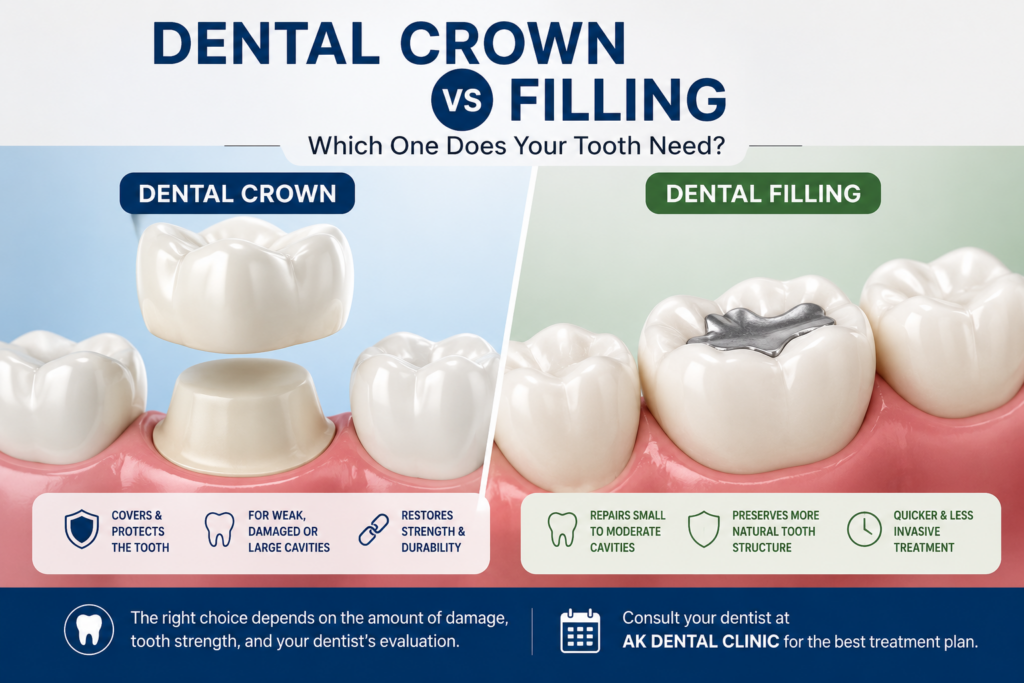
A filling is generally used when the tooth has enough healthy structure remaining to be repaired and restored.
A crown may be recommended when a tooth is significantly weakened, damaged, heavily restored, or has a large cavity that cannot be adequately protected with a filling.
So, how does a dentist decide between the two?
Let’s take a closer look.
What Is a Dental Filling?
A dental filling is used to repair a tooth affected by decay or certain types of minor damage.
The dentist removes the damaged portion of the tooth and fills the area with a restorative material.
The purpose is to:
- Remove decay
- Restore the shape of the tooth
- Protect the remaining tooth structure
- Restore normal chewing function
Fillings are generally appropriate when enough healthy tooth structure remains to support the restoration.
AK Dental Clinic provides dental fillings for teeth affected by cavities, decay, and minor damage.
What Is a Dental Crown?
A dental crown is a custom-made restoration that covers the visible portion of a tooth.
Instead of filling only the damaged area, a crown surrounds and protects the remaining tooth structure.
Crowns may be recommended for:
- Severely damaged teeth
- Large cavities
- Broken or weakened teeth
- Worn-down teeth
- Teeth after root canal treatment
- Certain cosmetic or structural concerns
AK Dental Clinic offers ceramic, porcelain-fused-to-metal, and zirconia crown options depending on the patient’s needs.
Dental Crown vs Filling: What’s the Main Difference?
The simplest way to understand the difference is:
Filling: Repairs a specific area of the tooth.
Crown: Covers and protects a significantly weakened tooth.
A dentist doesn’t choose a crown simply because it is considered “better.”
The treatment depends on how much healthy tooth structure remains and how much protection the tooth needs.
When Is a Dental Filling Usually Enough?
A filling may be suitable when:
- The cavity is relatively small or moderate.
- Most of the tooth structure is still strong.
- The tooth does not have a significant crack.
- The remaining tooth can support a filling.
- The tooth doesn’t require full coverage for protection.
For example, if you have a small cavity in an otherwise healthy tooth, placing a crown may be unnecessary.
A filling may provide an appropriate and more conservative restoration.
When Does a Tooth Need a Crown?
A crown may be recommended when a tooth has lost a significant amount of its structure.
This can happen because of:
- A large cavity
- A broken tooth
- A large existing filling
- Significant tooth wear
- A weakened tooth
- Previous dental treatment
- Root canal treatment
AK Dental’s crown service specifically lists severely damaged or broken teeth, large cavities where fillings are not sufficient, worn-down teeth, and teeth following root canal treatment among situations where crowns may be recommended.
Can a Large Cavity Be Treated With a Filling?
Sometimes.
The answer depends on how much healthy tooth structure remains after the decay is removed.
If enough strong tooth structure remains, a filling may be possible.
However, if a large portion of the tooth has been lost, a filling may not provide enough structural protection.
In such cases, your dentist may recommend a crown.
The decision should be made after examining the tooth rather than simply judging the size of the cavity from the outside.
What Happens If a Weak Tooth Only Gets a Filling?
If a tooth has lost a significant amount of its structure, it may be more vulnerable to further damage.
A large filling can restore the missing portion, but it doesn’t necessarily provide the same type of full-coverage protection as a crown.
If the remaining tooth structure is weak, biting forces may contribute to further cracking or fracture.
This is one reason your dentist may recommend a crown instead of simply placing another large filling.
Does Every Root Canal Need a Crown?
Not every tooth is identical, but teeth that have undergone root canal treatment may require additional protection depending on the tooth and the amount of remaining structure.
Root canal treatment removes infected or damaged pulp from inside the tooth and allows the natural tooth to be preserved.
After treatment, a crown may be recommended to provide additional strength and protection, particularly for teeth that experience significant chewing forces. AK Dental’s root canal treatment page also notes crown placement as part of restoring and protecting treated teeth.
Your dentist will assess the individual tooth before recommending the final restoration.
Can a Cracked Tooth Be Treated With a Filling?
It depends on the crack.
A very small area of damage may sometimes be restored conservatively.
However, a tooth with a significant crack may need greater protection.
A crown may be recommended in certain situations to help protect the remaining tooth structure.
If the crack extends deeply into the tooth or affects the root, treatment can be more complicated.
This is why a cracked tooth should be evaluated rather than repeatedly tested by chewing hard foods.
Which Is Stronger: A Filling or a Crown?
A crown generally provides more comprehensive coverage and protection because it covers the visible portion of the tooth.
A filling restores a specific damaged area.
However, this does not mean a crown should replace every filling.
If a tooth is healthy enough to be restored with a filling, a filling may be the more appropriate and conservative option.
The goal is to use the least extensive treatment that can properly restore and protect the tooth.
Is a Crown Better Than a Filling?
Not necessarily.
This is an important point.
A crown isn’t automatically a better treatment simply because it is more extensive.
If you have a small cavity and plenty of healthy tooth structure, a filling may be all you need.
If a tooth is severely weakened, a filling may not provide sufficient protection and a crown may be more appropriate.
The right treatment depends on your tooth.
Does a Crown Last Longer Than a Filling?
Both fillings and crowns can provide long-term service when properly placed and maintained.
Their longevity depends on factors such as:
- Oral hygiene
- Size of the restoration
- Bite forces
- Tooth location
- Material used
- Remaining tooth structure
- Teeth grinding or clenching
- Regular dental care
A large restoration on a heavily damaged tooth may have different long-term considerations compared with a small filling in a healthy tooth.
What Happens If You Delay Getting a Recommended Crown?
If a dentist recommends a crown because a tooth is significantly weakened, delaying treatment may allow the tooth to become more damaged.
A weakened tooth may eventually:
- Crack further
- Break
- Become painful
- Develop deeper decay
- Require root canal treatment
- Become difficult or impossible to save
This doesn’t mean every tooth needs immediate crown treatment.
But if your dentist has recommended a crown to protect a structurally weak tooth, it’s worth understanding why before postponing it.
How Does a Dentist Decide Between a Filling and Crown?
Your dentist may consider several factors.
Amount of tooth structure remaining
The more healthy tooth structure that remains, the more likely a conservative restoration may be possible.
Size of the cavity
Small and moderate cavities may often be treated with fillings, while very large cavities may require additional protection.
Location of the tooth
Back teeth experience significant chewing forces, which can influence the type of restoration recommended.
Cracks or fractures
A cracked or weakened tooth may require more extensive protection.
Previous dental treatment
A tooth that has undergone root canal treatment may require a crown depending on its condition.
Bite and chewing forces
Your bite can influence how much stress is placed on the tooth and restoration.
Overall oral health
Gum health, neighboring teeth, oral hygiene, and other factors may also influence the treatment plan.
Can a Dentist Tell Just by Looking at the Tooth?
Sometimes the problem is obvious, but not always.
Your dentist may need to use:
- Dental X-rays
- Clinical examination
- Bite evaluation
- Additional tests
- Examination of existing restorations
A tooth can appear relatively normal from the outside while having deeper decay or structural damage.
That’s why a proper examination is important before deciding between a filling and crown.
What Does the Treatment Process Look Like?
The process depends on whether you need a filling or crown.
For a filling, the dentist generally removes the decayed portion, cleans the area, places the restorative material, and shapes it to restore the tooth.
For a crown, the tooth may need to be prepared so that the crown can fit properly. The crown is then custom-made and placed over the prepared tooth.
The exact process varies depending on the tooth and type of restoration.
Can a Filling Prevent the Need for a Crown?
Early treatment can sometimes prevent a small cavity from becoming a larger structural problem.
If decay is treated while sufficient healthy tooth structure remains, a filling may be enough.
This is one reason regular dental check-ups are valuable even when your teeth don’t hurt.
A cavity can develop without causing noticeable symptoms in its early stages.
Dental Crown and Filling Treatment at AK Dental Clinic
At AK Dental Clinic in Manikonda, Hyderabad, our dentists evaluate the condition of the tooth before recommending a filling, crown, root canal, or another treatment.
The goal is to preserve as much healthy tooth structure as possible while providing the protection and function the tooth needs.
AK Dental provides both dental fillings and dental crowns, with crown options including ceramic, porcelain-fused-to-metal, and zirconia restorations.
If the tooth is infected or has significant internal damage, root canal treatment may be recommended to save the natural tooth before restoring it.
Patients from Manikonda, Narsingi, Gachibowli, Puppalaguda, Kokapet, Financial District, and nearby areas can visit AK Dental Clinic for a comprehensive dental evaluation.
Frequently Asked Questions
Is a filling better than a crown?
Neither is automatically better. A filling may be appropriate for a tooth with limited damage, while a crown may be recommended when a tooth is significantly weakened or damaged.
How do I know if I need a filling or crown?
The decision depends on the amount of decay or damage, remaining tooth structure, cracks, bite forces, and overall condition of the tooth. A dentist should examine the tooth before making the recommendation.
Can a large cavity be filled instead of crowned?
Sometimes, but not always. If too much tooth structure has been lost, a filling may not provide sufficient strength and protection.
Does a root canal require a crown?
A crown may be recommended after root canal treatment, particularly when the treated tooth has significant structural loss or experiences substantial chewing forces. Your dentist will assess the tooth individually.
Is getting a crown painful?
The tooth is generally treated under local anesthesia during crown preparation. Your dentist will explain the procedure and what you can expect before treatment.
Can a broken tooth be repaired with a filling?
A minor chip or limited damage may sometimes be restored with a filling or bonding. A significantly broken or weakened tooth may require a crown or another treatment.
What happens if I don’t get a crown when my dentist recommends one?
A weakened tooth may be at greater risk of further damage or fracture. Ask your dentist why a crown has been recommended and what could happen if treatment is delayed.
Can a filling fall out?
Yes. Fillings can become damaged, worn, or dislodged, particularly when a tooth experiences significant chewing forces. If a filling comes out, have the tooth examined rather than simply leaving it untreated.
How long does a dental crown last?
The lifespan of a crown depends on factors such as oral hygiene, bite forces, material, tooth condition, and regular dental care. Your dentist can advise you on caring for your specific restoration.
Which Treatment Does Your Tooth Need?
A cavity doesn’t automatically mean you need a crown.
Likewise, a large filling isn’t always the best solution for a severely weakened tooth.
The right treatment depends on how much healthy tooth structure remains, how damaged the tooth is, and how much protection it needs.
If you’re unsure whether you need a dental filling, crown, or root canal, don’t wait until the tooth becomes painful or breaks.
Book a dental examination at AK Dental Clinic in Manikonda, Hyderabad, and let our dental team assess your tooth and recommend the most appropriate treatment.