
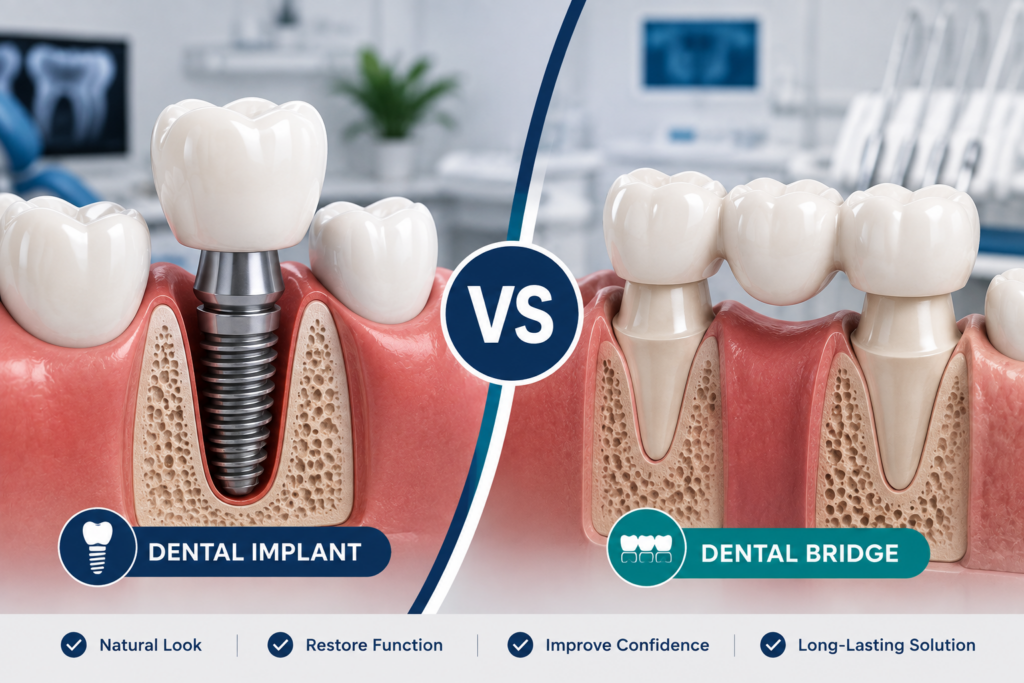
Losing a tooth can affect much more than your smile. A missing tooth can make chewing difficult, affect the way your teeth come together, and allow nearby teeth to shift over time.
Fortunately, there are several ways to replace a missing tooth. Two commonly considered options are a dental implant and a dental bridge.
But which one is better?
The answer depends on your oral health, the condition of the surrounding teeth and bone, your treatment goals, and your budget. In this guide, we’ll explain the differences between dental implants and dental bridges so you can have a more informed discussion with your dentist.
What Is a Dental Implant?
A dental implant is a tooth-replacement option that uses a small titanium or other biocompatible implant placed into the jawbone.
The implant acts as an artificial tooth root. After the implant integrates with the surrounding bone, it can support a dental crown that replaces the visible portion of the missing tooth.
A typical implant-supported tooth has three components:
- Dental implant
- Abutment
- Dental crown
Because the implant is anchored in the jawbone, it can provide a stable foundation for the replacement tooth.
What Is a Dental Bridge?
A dental bridge replaces a missing tooth by using the teeth adjacent to the gap for support.
A traditional bridge generally consists of a replacement tooth, called a pontic, attached to crowns that fit over the neighboring supporting teeth.
Unlike an implant, a conventional bridge does not replace the missing tooth root.
Dental Implant vs Dental Bridge: At a Glance
| Feature | Dental Implant | Dental Bridge |
|---|---|---|
| Replaces the tooth root | Yes | No |
| Uses neighboring teeth for support | Usually no | Yes |
| Jawbone stimulation | Yes | No |
| Surgery required | Usually | Usually no implant surgery |
| Treatment time | Generally longer | Generally shorter |
| Cleaning | Similar to natural teeth, with additional attention around implant | Requires cleaning underneath the bridge |
| Can be used for one missing tooth | Yes | Yes |
| Suitability | Depends on bone and overall oral health | Depends on supporting teeth and gum health |
Your dentist needs to examine your mouth before determining which option is appropriate.
How Does a Dental Implant Work?
Dental implant treatment generally involves several stages.
1. Dental Examination
Your dentist evaluates the missing tooth area, gums, neighboring teeth, and available bone.
Dental X-rays or other imaging may be recommended to assess the treatment site.
2. Implant Placement
The implant is placed into the jawbone under appropriate local anesthesia.
3. Healing and Integration
The implant needs time to integrate with the surrounding bone. The exact healing period varies between patients and depends on factors such as bone quality and the treatment site.
4. Abutment and Crown
Once the implant is ready for restoration, an abutment and custom-made dental crown can be attached.
The final restoration is designed to function and look as naturally as possible.
How Does a Dental Bridge Work?
A bridge generally requires preparation of the supporting teeth next to the missing tooth.
The dentist takes impressions or digital scans of the area, and a laboratory creates the bridge.
Once it is ready, the bridge is fitted and cemented into position.
One of the advantages of a bridge is that treatment can generally be completed without placing an implant into the jawbone.
Which Is Better: Implant or Bridge?
There isn’t one answer that is right for every patient.
A dental implant may be a good option when:
- You have a suitable amount of healthy bone.
- The surrounding teeth are healthy.
- You want a tooth replacement that does not depend on neighboring teeth.
- You are looking for a long-term replacement option.
- Your general oral health is suitable for implant treatment.
A bridge may be considered when:
- The neighboring teeth already require crowns or significant restoration.
- You prefer to avoid implant surgery.
- The clinical situation makes a conventional bridge appropriate.
- A quicker tooth-replacement option is preferred.
Your dentist should evaluate your individual situation before recommending one treatment over another.
What About the Jawbone?
One important difference between the two treatments is what happens to the area where the natural tooth root was located.
A dental implant is placed into the jawbone and functions as an artificial root. This allows the implant to provide stimulation to the surrounding bone.
With a conventional bridge, there is no implant replacing the missing root.
After tooth loss, the bone in the area can gradually change. Your dentist can assess the condition of the bone and explain whether additional treatment may be necessary before an implant is placed.
What About the Teeth Next to the Missing Tooth?
This is another important difference.
A conventional bridge typically relies on neighboring teeth for support. Those teeth may need to be prepared to accommodate the bridge.
A single dental implant generally does not require the adjacent healthy teeth to be used as bridge supports.
This can make implants particularly attractive when the neighboring teeth are healthy and do not otherwise need extensive dental work.
Which Treatment Looks More Natural?
Both modern dental implants and bridges can be designed to look natural.
The final appearance depends on factors such as:
- Tooth shape
- Tooth color
- Gum appearance
- Position of the missing tooth
- Quality of the dental restoration
- Skill and planning involved in the treatment
A properly designed restoration should blend with the surrounding teeth as closely as possible.
Which One Is Easier to Maintain?
Both require good oral hygiene and regular dental check-ups.
With an implant, you need to clean around the crown and gum area carefully.
With a bridge, special attention is needed underneath the replacement tooth because food and plaque can accumulate beneath the bridge.
Your dentist or dental hygienist can demonstrate the appropriate brushing and interdental cleaning techniques for your restoration.
Which Treatment Lasts Longer?
Both implants and bridges can provide long-term tooth replacement when properly planned, placed, maintained, and monitored.
However, longevity varies considerably from person to person.
Factors that can affect the lifespan of a restoration include:
- Oral hygiene
- Gum health
- Bite forces
- Smoking or tobacco use
- Diet and habits
- Regular dental visits
- Quality and condition of the restoration
- Health of the supporting structures
Rather than choosing a treatment based only on expected lifespan, it is better to consider which option is most appropriate for your particular mouth.
Is a Dental Implant More Expensive Than a Bridge?
The initial cost of a dental implant is often higher than that of a conventional bridge because implant treatment involves additional surgical and restorative stages.
However, treatment cost should not be the only factor when comparing the two.
The total cost can depend on:
- Number of teeth being replaced
- Type of implant
- Type of crown
- Bone condition
- Need for additional procedures
- Laboratory charges
- Complexity of the case
At AK Dental Clinic, the recommended treatment and cost can be discussed after examining your teeth and treatment requirements.
What If You Have Bone Loss?
Not everyone who has lost a tooth has enough bone immediately available for implant placement.
Depending on the situation, your dentist may discuss procedures designed to improve the available bone before or during implant treatment.
Whether this is necessary can only be determined after a clinical examination and appropriate imaging.
Can a Dental Implant Be Placed Immediately After Extraction?
In selected cases, an implant may be placed at the time of tooth extraction.
However, immediate implant placement is not suitable for every patient.
The decision depends on factors such as:
- Condition of the extraction site
- Presence and severity of infection
- Amount and quality of available bone
- Gum condition
- Overall treatment plan
Your dentist will determine whether immediate or delayed implant placement is more appropriate.
What Happens If You Don’t Replace a Missing Tooth?
Leaving a missing tooth untreated may cause changes in your bite and the position of neighboring teeth.
You may also experience difficulty chewing, depending on which tooth is missing.
Over time, the bone in the area of the missing tooth can also change.
This does not mean that every missing tooth must immediately be replaced. Your dentist can evaluate your individual situation and explain whether replacement is recommended.
Dental Implant or Bridge: Which Should You Choose?
Think of the decision this way:
A dental implant may be worth considering if:
You want to replace a single missing tooth without relying on the neighboring teeth and you have suitable bone and oral health for implant treatment.
A bridge may be worth considering if:
The neighboring teeth are suitable to support a bridge, you prefer a non-implant option, or your clinical circumstances make a bridge more appropriate.
There is no universal “best” treatment.
The best option is the one that fits your dental condition, long-term goals, and overall oral health.
Why Choose AK Dental Clinic in Manikonda?
At AK Dental Clinic, Manikonda, Hyderabad, we assess each missing-tooth case individually before recommending treatment.
Our approach includes evaluating:
- The missing tooth and surrounding teeth
- Gum health
- Available bone
- Your bite
- Your expectations
- Suitable tooth-replacement options
Depending on your situation, we can discuss options such as dental implants, bridges, or other appropriate restorations.
We provide dental care for patients from Manikonda, Narsingi, Gachibowli, Puppalaguda, Kokapet, Financial District, and surrounding areas.
Frequently Asked Questions
Is an implant better than a bridge?
An implant can offer important advantages, particularly because it replaces the missing tooth root and generally does not require healthy neighboring teeth to support the replacement tooth. However, a bridge can be an excellent option in appropriate cases.
Is a dental bridge faster than an implant?
A conventional bridge generally requires fewer treatment stages than an implant. Implant treatment includes a healing period before the final restoration can be placed.
Can I get an implant if I have bone loss?
Possibly. Some patients with insufficient bone may require additional treatment before an implant can be placed. Your dentist will need to evaluate your bone and treatment site.
Are dental implants painful?
Implant placement is performed under local anesthesia. Some soreness or discomfort can occur after the procedure, and your dentist will provide appropriate aftercare instructions.
How do I clean a dental bridge?
You need to clean around the supporting teeth and underneath the replacement tooth. Your dentist can show you the best brushing and interdental cleaning method for your particular bridge.
Can an implant look like a natural tooth?
Yes. A custom dental crown can be designed to match the shape, color, and appearance of your surrounding teeth.
Don’t Leave a Missing Tooth Unchecked
If you have lost a tooth, you don’t necessarily have to live with a gap.
Dental implants and bridges can both provide effective ways to restore your smile and chewing function, but the right choice depends on your individual dental condition.
Book a consultation at AK Dental Clinic in Manikonda, Hyderabad, and let our dental team evaluate your missing tooth and explain the treatment options available for you.