
When a tooth becomes severely infected or damaged, many patients ask the same question:
“Should I get a root canal, or should I simply have the tooth removed?”
The answer depends on the condition of the tooth, the surrounding bone, and your long-term oral health goals. In most cases, saving your natural tooth is the preferred option, provided it can be restored successfully.
This guide explains the differences between root canal treatment and tooth extraction, helping you make an informed decision.
What Is a Root Canal?
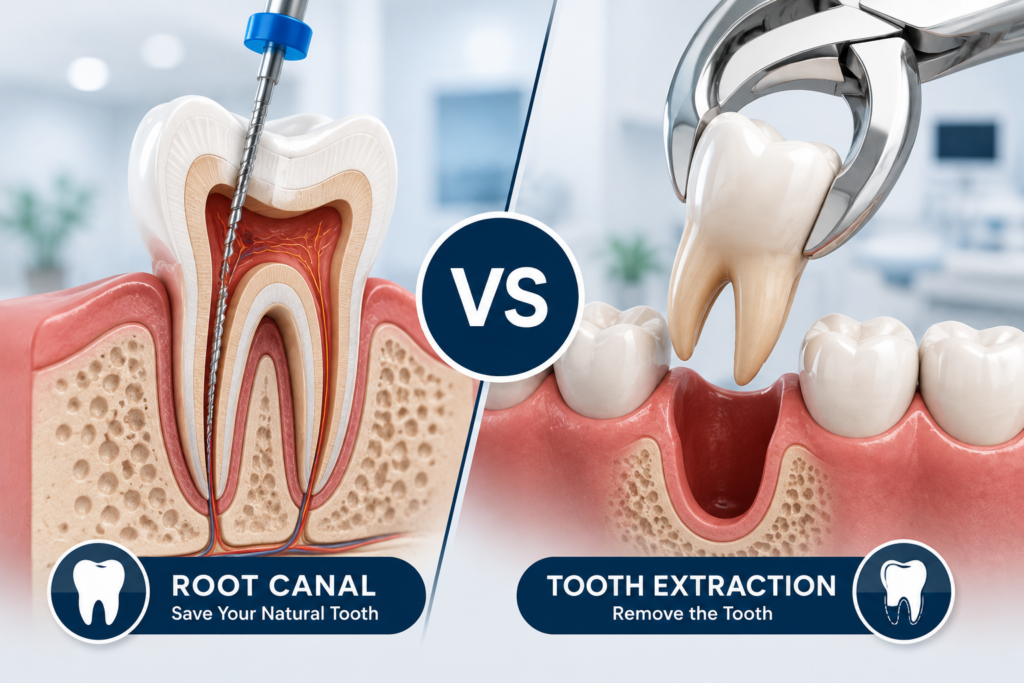
A root canal is a procedure that removes infected or damaged pulp from inside a tooth. The canals are cleaned, disinfected, filled, and sealed, allowing the natural tooth to remain functional.
After treatment, a dental crown is often recommended for back teeth to restore strength and protect the tooth from fracture.
What Is a Tooth Extraction?
A tooth extraction involves removing the entire tooth from the jaw.
Extraction may be necessary if the tooth:
- Is fractured beyond repair
- Has extensive decay that cannot be restored
- Has severe bone loss from advanced gum disease
- Cannot be treated successfully with a root canal
Once a tooth is removed, replacing it with a dental implant, bridge, or denture is usually recommended to restore chewing function and help prevent neighboring teeth from shifting.
Root Canal vs Tooth Extraction
| Feature | Root Canal | Tooth Extraction |
|---|---|---|
| Saves your natural tooth | Yes | No |
| Chewing ability | Preserved | Reduced until replacement |
| Recovery | Usually a few days | Often longer, especially if replacement is needed |
| Need for replacement | Usually not | Often yes |
| Long-term cost | Often lower when the tooth is restorable | Can be higher if an implant or bridge is required |
When Is a Root Canal the Better Choice?
Your dentist may recommend a root canal if:
- The tooth can still be restored
- The surrounding bone is healthy
- The tooth has enough remaining structure
- There is no vertical root fracture
- You want to preserve your natural bite
Saving a natural tooth helps maintain chewing efficiency and jawbone health.
When Is Extraction Necessary?
Extraction may be the better option if:
- The tooth is split vertically
- There is extensive decay below the gumline
- Severe infection has destroyed too much tooth structure
- Advanced periodontal disease has made the tooth unstable
- The tooth cannot be predictably restored
Your dentist will explain why extraction is recommended and discuss suitable replacement options.
Why Saving Your Natural Tooth Matters
Whenever possible, keeping your natural tooth offers several advantages:
- Maintains normal chewing function
- Helps preserve jawbone structure
- Keeps neighboring teeth in position
- Avoids more complex replacement procedures
- Often feels more natural than an artificial replacement
What Happens After an Extraction?
If a tooth is removed and not replaced, you may experience:
- Shifting of nearby teeth
- Difficulty chewing
- Changes in your bite
- Increased stress on remaining teeth
- Gradual bone loss in the jaw
To avoid these issues, your dentist may recommend:
- Dental implants
- Dental bridges
- Partial dentures
Cost Considerations
Many patients choose extraction because they assume it is less expensive.
While the initial extraction fee may be lower, replacing a missing tooth with an implant or bridge can increase the total treatment cost over time.
In many situations, restoring a tooth with a root canal and crown can be a more cost-effective long-term solution.
How Your Dentist Decides
At AK Dental Clinic, every decision begins with a comprehensive examination.
We assess:
- Digital X-rays
- The amount of healthy tooth remaining
- Bone support
- Gum health
- The extent of infection
- Your overall oral health
Based on these findings, we’ll recommend the option that offers the best long-term outcome.
Frequently Asked Questions
Is a root canal always better than extraction?
Not always. If the tooth is restorable, preserving it is often the preferred approach. However, if the damage is too extensive, extraction may be the better option.
Can I get an implant immediately after extraction?
In some cases, yes. Whether immediate placement is appropriate depends on factors such as infection, bone quality, and overall oral health.
Will I need a crown after a root canal?
Back teeth often require a crown to restore strength and reduce the risk of fracture.
What happens if I don’t replace an extracted tooth?
Leaving a gap can lead to shifting teeth, bite changes, and bone loss over time.
Why Choose AK Dental Clinic?
At AK Dental Clinic, Manikonda, we provide personalized treatment planning based on your specific dental condition.
Patients from Manikonda, Gachibowli, Narsingi, Puppalaguda, Kokapet, and the Financial District trust us for conservative, evidence-based dental care focused on preserving natural teeth whenever possible.
Whether you need a root canal, extraction, or tooth replacement, we’ll explain your options clearly so you can make an informed decision.